If you have a herniated disc, sciatica or spinal stenosis in your lower back, an epidural steroid injection is often one of the first treatments offered after medication and physiotherapy. Many patients ask us whether they should get the injection, try non-surgical spinal decompression, or both.
This guide compares the two side by side: how each works, how long relief typically lasts, the risks, the cost in Ontario, and how to decide what’s right for you.
The short answer
- An epidural steroid injection delivers a powerful anti-inflammatory medication (a corticosteroid) next to an irritated nerve in the lower back. Its goal is to calm inflammation and reduce pain, often for weeks to a few months.
- Non-surgical spinal decompression gently stretches the lower spine at the injured disc level to reduce pressure inside the disc and on the nerve. It aims at the mechanical cause of disc-related pain over a 4–6 week program.
In simple terms, an injection mainly treats the inflammation, while decompression aims at the pressure that is causing it. That difference explains most of what follows.
What is an epidural steroid injection?
An epidural steroid injection (ESI) is a procedure in which a physician injects a corticosteroid, often mixed with a local anaesthetic, into the epidural space. That is the area around the spinal nerves in the lower back. It is usually done with X-ray guidance (fluoroscopy) to place the needle accurately.
Common types for lower back pain include:
- Transforaminal, where the needle goes into the opening where a specific nerve root exits the spine
- Interlaminar, which goes between two vertebrae at the back of the spine
- Caudal, which goes through an opening at the base of the spine near the tailbone

The procedure takes about 15–30 minutes. Patients typically go home the same day and are asked to rest for the remainder of the day.
What injections are good at
Epidural injections can provide meaningful short-term relief of leg pain (sciatica) caused by an inflamed nerve root. For some patients, this relief creates a window to move more comfortably and take part in rehabilitation.
Their limitations
- Relief is often temporary. Many patients find the effect wears off over weeks to a few months.
- They don’t change the disc. The steroid reduces inflammation, but it doesn’t take pressure off the disc or change what is pressing on the nerve.
- There are limits on how many you can have. Because of the cumulative effects of steroids on bone, blood sugar and other tissues, physicians usually limit the number of injections per year.
- They’re less effective for back pain alone. The research is strongest for leg pain from a pinched nerve. It is weaker for back pain without leg symptoms, and for spinal stenosis.
What is non-surgical spinal decompression?
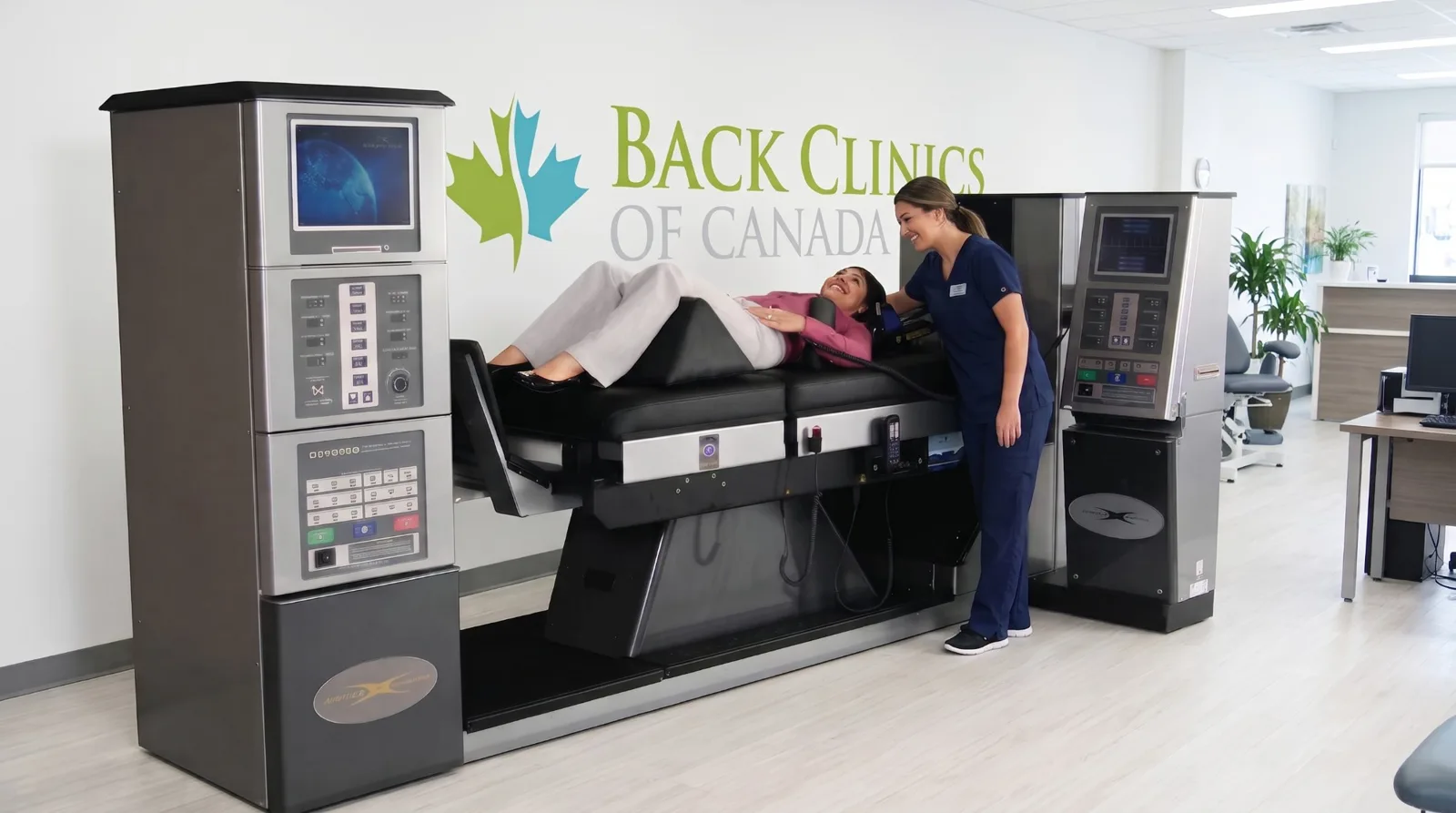
Non-surgical spinal decompression uses a computer-controlled table such as the DRX9000 or SpineMED. You lie comfortably, fully clothed, with a harness around your pelvis. The table applies a precise, gradually changing stretch targeted at the injured lumbar disc, such as L4-L5 or L5-S1.
Because the computer constantly adjusts the force, your back muscles don’t tense up against it, as they often do with basic traction. The goals are to:
- Lower the pressure inside the disc, which may help bulging or herniated material move away from the nerve
- Draw water, oxygen and nutrients back into the disc to support healing
- Open space around compressed nerve roots
Each session takes just over 23 minutes, with no needles, medication or downtime. A typical program is about 20 sessions over 4–6 weeks. At Back Clinics of Canada, decompression is combined with Class IV laser therapy to reduce inflammation and Disc Renewal Plus™ nutritional support for disc health. When your treatment plan calls for it, we also include physical therapy to strengthen and stabilize your spine as you heal.
Learn more about non-surgical spinal decompression →
Side-by-side comparison
| Epidural steroid injection | Non-surgical spinal decompression | |
|---|---|---|
| What it targets | Inflammation around the nerve | Pressure inside the disc and on the nerve |
| How it’s done | Needle into the spine, usually under X-ray guidance | Computer-guided stretch on a treatment table |
| Medication | Corticosteroid, often with anaesthetic | None |
| Needles | Yes | No |
| Time per treatment | 15–30 minutes, plus rest that day | just over 23 minutes, back to normal activity |
| Number of treatments | 1 at a time, with limits per year | About 20 sessions over 4–6 weeks |
| Typical relief pattern | Often within days, frequently temporary | Gradual; many patients notice improvement around sessions 6–10 |
| Main side effects | Injection-site pain, headache, raised blood sugar, flushing, sleep problems; rare serious complications | Temporary mild soreness after the first sessions |
| Best evidence for | Short-term relief of sciatica (leg pain) | Disc-related low back and leg pain |
| Coverage in Ontario | Often covered by OHIP when performed by a physician | Not OHIP; often covered by extended health plans under chiropractic benefits |
The benefits of decompression compared with injections
| Epidural injection | Non-surgical decompression benefit |
|---|---|
| Uses a steroid drug, which can raise blood sugar (a concern with diabetes) and, with repeated use, affect bone density | Drug-free. Nothing is injected or taken. |
| A needle placed near the spinal nerves, with rare but serious risks | No needles. You stay fully clothed on a padded table. |
| Mainly calms inflammation; the disc pressing on the nerve is unchanged | Aims at the disc itself by reducing pressure and supporting rehydration and healing |
| Relief often fades, leading to repeat injections, up to a yearly limit | A complete program designed for lasting improvement, with progress checked session by session |
| Rest needed after the procedure | No downtime. Most patients return to work right after a session. |
| Requires a referral, often with a wait for a pain clinic | No referral needed. Free consultation usually within 2 business days. |
What does the research say?
- A large systematic review in the Annals of Internal Medicine (Chou et al., 2015) found that epidural steroid injections for sciatica gave small, short-term improvements in pain and function, with no clear long-term benefit, and no meaningful effect on the need for surgery later.
- A major trial in the New England Journal of Medicine (Friedly et al., 2014) found that for lumbar spinal stenosis, adding a steroid to the injection gave little or no additional benefit over an anaesthetic alone at six weeks.
- In 2014, the U.S. Food and Drug Administration required a warning on injectable corticosteroids about rare but serious neurological events with epidural use, including stroke and paralysis.
- For non-surgical decompression, smaller studies have reported reduced pain and disability in patients with disc herniation and discogenic low back pain (for example, Apfel et al., BMC Musculoskeletal Disorders, 2010). Larger high-quality trials are still needed, and we’re upfront with patients about that.
The takeaway: injections can be a useful short-term tool, especially for severe leg pain. For lasting improvement in disc-related pain, many patients look for an approach that targets the disc itself.
Sources: Chou R et al., Ann Intern Med 2015 · Friedly JL et al., NEJM 2014 · Apfel CC et al., BMC Musculoskelet Disord 2010
What I hear from patients after epidural injections
By Dr. Ron Nusbaum, DC
Over more than 37 years of practice, I’ve spoken with a great many patients who came to our clinic after having one or more epidural steroid injections. Almost without exception, they tell me the same story: the injection gave them no relief at all, or relief that was short-lived and modest before the pain returned.
What stays with me is not just the pain. It’s the frustration and worry that follow. Many patients had pinned their hopes on the injection. When it didn’t work, or wore off within weeks, their pain often felt worse, and so did their anxiety about what comes next. They ask me: “If the injection didn’t work, am I headed for surgery? Is this my life now?” Many also tell me the injection itself was an unpleasant experience they don’t want to repeat.
To be fair, I mostly meet the patients for whom injections didn’t work. Those who were helped don’t usually come looking for us. But it’s a common enough story that I want patients to know this: an injection that didn’t help is not the end of the road. It often means the steroid calmed some inflammation but did nothing about the pressure on the disc. That is the problem decompression is designed to address.
Can you have both?
Yes. These treatments aren’t mutually exclusive. Some patients with severe sciatica have an injection to calm acute nerve pain, then start a decompression program to address the disc. Others have already had one or more injections that wore off, and come to us looking for something longer lasting.
If you’ve had an injection recently or have one scheduled, tell us at your consultation. We’ll plan your decompression program around it.
Which should you choose?
An epidural injection may make sense if:
- Your leg pain is severe and you need fast, short-term relief
- Your physician has recommended it as part of a broader plan
- You can’t yet tolerate other treatments because of acute pain
Non-surgical decompression may be a good fit if:
- You have a herniated or bulging disc, sciatica, degenerative disc disease or spinal stenosis in the lower back
- You’ve had injections that helped only temporarily
- You prefer to avoid needles and steroid medication, or have diabetes or bone-density concerns
- You want a treatment aimed at the disc rather than the symptoms
- You’re waiting for an injection or surgical appointment and don’t want to wait in pain
Seek emergency care immediately if you have loss of bladder or bowel control, numbness in the groin or inner thighs, or rapidly worsening leg weakness. These need urgent medical assessment.
Has surgery been suggested? Read Spinal Decompression Surgery vs. Non-Surgical Spinal Decompression to understand the difference.
Get a non-surgical assessment in Vaughan and Toronto
Back Clinics of Canada has treated disc-related back pain for over 37 years and has delivered over 250,000 treatments. Your free consultation includes a review of your MRI or X-rays and a clinical assessment, and it is usually available within 2 business days. No referral is needed. Your free consultation screens for conditions that rule out decompression, and we’ll tell you if you’re not a candidate.
Coming from Toronto? We’re at Rutherford Rd & Jane St in Vaughan, just off Highway 400, with free on-site parking. You can also take TTC Line 1 to Vaughan Metropolitan Centre, then a YRT bus. Directions for Toronto patients →
Book your free consultation · Call (416) 633-3666
Frequently asked questions
Is spinal decompression better than an epidural injection? They do different things. An injection reduces inflammation around the nerve, usually for a limited time. Decompression aims to reduce pressure on the disc and nerve over a full program. For many people with disc-related lower back pain, decompression is a drug-free option to try. Some benefit from both.
How long does an epidural steroid injection last? It varies widely. Some people get relief for a few weeks, others for a few months, and some get little relief. Research shows the benefit is mostly short term.
Can I get spinal decompression after an epidural injection? Yes. Many of our patients have had one or more injections before starting decompression. Let us know the date of your last injection at your consultation.
Is an epidural injection covered by OHIP? Injections performed by a physician are often covered by OHIP, although wait times can apply. Non-surgical decompression isn’t covered by OHIP but is often covered by extended health plans under chiropractic benefits, and financing is available.
Does spinal decompression hurt? Most patients find it comfortable, and many find it relaxing. Mild soreness after the first few sessions is the most common side effect.
I have diabetes. Should I avoid steroid injections? Steroid injections can temporarily raise blood sugar, so discuss this with your physician. Decompression involves no medication, which is one reason some patients with diabetes prefer to try it.
Medically reviewed by Dr. Ron Nusbaum, DC · Last updated: November 2026 This article is for general information and is not a substitute for individual medical advice. Talk to your physician before changing any treatment plan.
Not Sure What Is Causing Your Pain?
Book a free consultation. We will review your history and your imaging, then tell you honestly whether we can help.